See it with fire
The candle flames rise and fall in a pattern. That pattern is compression and rarefaction made visible.
In every version: sound creates alternating zones of compression and rarefaction. The flames make those invisible zones visible.


Sound waves move by squeezing and stretching the particles they pass through. The squeezed regions are called compressions; the stretched regions are rarefactions. Watch them in the visualizer below.
Parameters
Sound is not a sine curve
orKey terms
When a sound wave moves through a medium, it creates two alternating zones: SPI Exam Topic
High pressure
High density
Low pressure
Low density
Tap each card to learn about the underlying physics.
In ultrasound
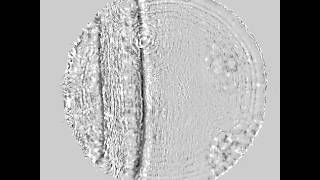
This is compression and rarefaction happening with an actual ultrasound transducer. SPI Exam Topic
Schlieren imaging makes the invisible pressure waves from an ultrasound scan visible.
Everything you learned on the previous tabs (compression zones, rarefaction zones, pressure differences, density changes) is exactly what's happening every time a sonographer places a transducer on a patient.
Quick check
Review Complete
You've finished the compression and rarefaction check-in.